
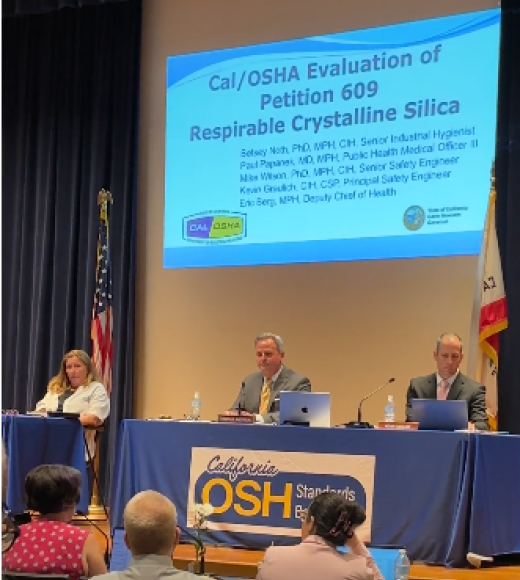
On May 21, 2026, the California Occupational Safety and Health Standards Board (Board) met in Downtown Los Angeles to discuss and vote on a petition submitted by the Western Occupational and Environmental Medical Association (WOEMA) seeking expedited rulemaking to amend Title 8 California Code of Regulations Section 5204 - Occupational Exposures to Respirable Crystalline Silica. The proposed revisions would prohibit all fabrication and installation tasks involving engineered stone that contains more than 1% crystalline silica due to the significant health risks associated with worker exposure.
The Board meeting drew widespread attention from occupational safety and health professionals, medical experts, worker advocates, public health officials, attorneys, industry representatives, and affected workers and their families. Public testimony throughout the meeting highlighted the growing urgency surrounding engineered stone-associated silicosis, the devasting impacts of this disease on workers and their families, and the need to protect workers in California.
Supporters of the petition emphasized the need for immediate regulatory action without additional advisory committee study requirements, arguing that the severity of the disease and the increasing number of cases warrant expedited intervention. Several speakers noted that existing engineering controls and personal protective equipment have not been sufficient to adequately control worker exposure to respirable crystalline silica during fabrication and installation activities involving engineered stone. In addition, alternatives to engineered stone are available on the market, such as natural stone slabs and recycled glass.
Industry representatives emphasized the importance of worker training, Cal/OSHA's failed enforcement of existing regulations, and the use of wet methods when working with engineered stone. Industry stakeholders expressed opposition to a blanket ban on engineered stone products, arguing that the material can be handled safely when appropriate exposure control measures are implemented. Opponents of the petition also argued that a ban would be harder to enforce, as materials could enter California from other states and Mexico.
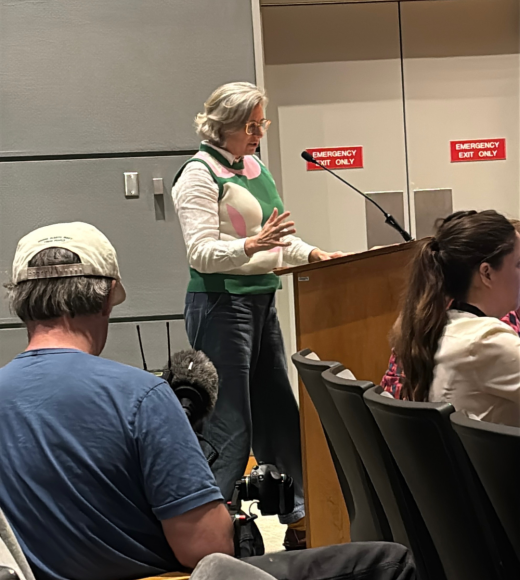
Among those providing testimony was Dr. Rachael Jones, Director of the Southern California Education and Research Center (SCERC), who urged the Board to take decisive action.
"We've recognized this hazard for some time, but it's the accumulation of human misery that we've heard today and over the years, that brought us here today," Dr. Jones stated during public comment. "California should be a model for the nation and create momentum for the use of safer products and the protection of workers and the efficient use of our public health workforce to address problems that are emerging today. I urge the board to support the petition as submitted by WOEMA and enable Cal/OSHA to move forward with an expeditious emergency rulemaking to regulate this product more fully and prevent this disease."
Following public comments, the Board unanimously voted to grant the WOEMA petition to the extent Cal/OSHA drafts emergency rulemaking to amend Title 8 California Code of Regulations Section 5204 - Occupational Exposures to Respirable Crystalline Silica. The Board simultaneously requested Cal/OSHA to convene advisory committees to evaluate the feasibility and implications of potential worker protections related to silica exposure.
What Does This Vote Mean?
The Board's vote does not immediately ban the fabrication and installation of engineered stone in California. Instead, it directs Cal/OSHA to begin drafting emergency regulation while simultaneously gathering input to inform future regulation.
As part of this process, Cal/OSHA will convene an advisory committee composed of diverse stakeholders. The committee will evaluate the feasibility and economic viability of the proposed emergency regulation and review recommendations provided by the scientific subcommittee.
During the meeting, Board Chair Joseph Alioto Jr. identified several key issues for further evaluation by the advisory committee:
- Whether proposed regulation should apply to workers in the construction industry
- Whether other high-silica-content natural stone products, such as quartzite, should be included in future regulatory action
- How zero-silica alternative materials can be incorporated into any future regulatory action
At the same time, Cal/OSHA will convene a scientific subcommittee consisting of independent scientists and medical experts to address two fundamental questions:
- Can engineered stone be fabricated safely?
- Can other high-silica content natural stone products be fabricated safely?
The subcommittee is expected to report its findings to the Board by August 20, 2026.
In parallel, Cal/OSHA will begin drafting an emergency temporary standard that would prohibit fabrication and installation tasks involving engineered stone that contains more than 1% crystalline silica. The proposed emergency standard will be informed by both the advisory committee's recommendations and the scientific subcommittee's findings before being considered by the Board.
The Board's action represents one of the most significant regulatory steps California has taken to address the growing epidemic of engineered stone-associated silicosis. While scientific questions remain, the vote signals a commitment by state regulators to evaluate whether stronger measures - including banning the fabrication and installation of engineered stone products - are necessary to prevent future cases of this entirely preventable occupational disease.
Background on Engineered Stone and Silicosis in California
In California, across the United States, and internationally, a growing epidemic of silicosis - an occupational lung disease - is being observed as a result of exposure to respirable crystalline silica from engineered stone.
According to a report published by the UCLA Center for Occupational and Environmental Health:
"Engineered stone, also known as artificial stone, is commonly used for kitchen, bathroom, and other countertops and is characterized by its high crystalline silica content, which can exceed 90% [1-3]. Workers who fabricate engineered stone slabs into countertops have been found to experience exposures to respirable crystalline silica in excess of occupational permissible exposure limits [4-7] and to develop silicosis at relatively young ages after comparatively short durations of exposure [8-11]."
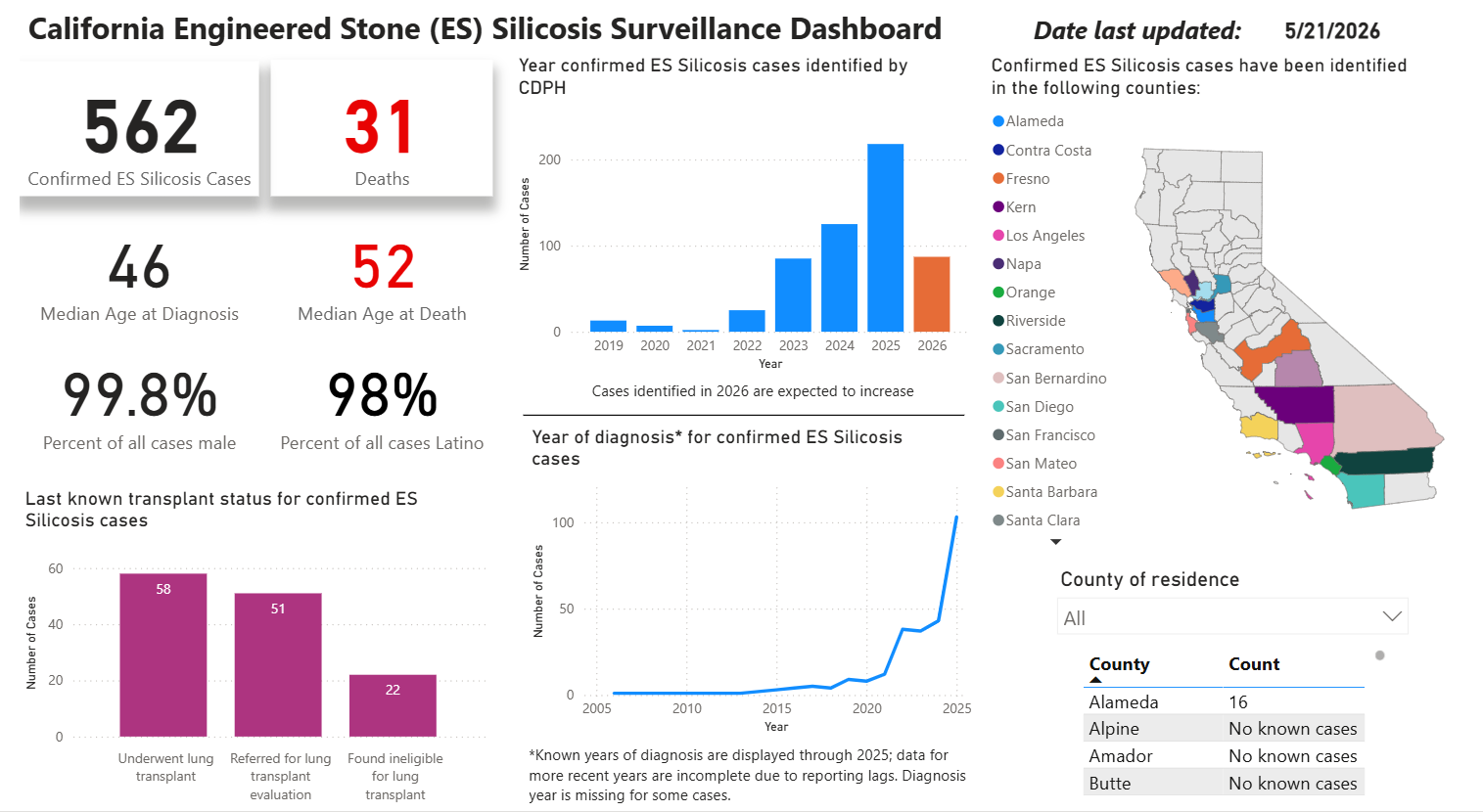
According to the California Department of Public Health (CDPH), as of May 21, 2026, 562 confirmed cases of silicosis attributed to engineered stone have been identified in California (see figure below). Of these cases, 288 have been identified in Los Angeles County and 120 in Orange County. These cases are anticipated to represent only a fraction of the true number of affected workers due to underdiagnosis and barriers to healthcare access among vulnerable worker populations.
References
- Ramkissoon, C., et al., Characterisation of dust emissions from machined engineered stones to understand the hazard for accelerated silicosis. Sci Rep, 2022. 12(1): p. 4351.
- Carrieri, M., et al., Characterization of Silica Exposure during Manufacturing of Artificial Stone Countertops. Int J Environ Res Public Health, 2020. 17(12): p. 4489.
- León-Jiménez, A., et al., Compositional and structural analysis of engineered stones and inorganic particles in silicotic nodules of exposed workers. Part Fibre Toxicol, 2021. 18(1): p. 41.
- Surasi, K., et al., Elevated exposures to respirable crystalline silica among engineered stone fabrication workers in California, January 2019-February 2020. Am J Ind Med, 2022. 65(9): p. 701-707.
- Salamon, F., et al., Occupational exposure to crystalline silica in artificial stone processing. J Occup Environ Hyg, 2021. 18(12): p. 547-554.
- Seneviratne, M., et al., Respirable Silica Dust Exposure of Migrant Workers Informing Regulatory Intervention in Engineered Stone Fabrication. Saf Health Work, 2024. 15(1): p. 96-101.
- Weller, M., et al., An assessment of worker exposure to respirable dust and crystalline silica in workshops fabricating engineered stone. Ann Work Expo Health, 2024. 68(2): p. 170-179.
- Guarnieri, G., et al., Silicosis in finishing workers in quartz conglomerates processing. Med Lav, 2020. 111(2): p. 99-106.
- Hoy, R.F., et al., Artificial stone-associated silicosis: a rapidly emerging occupational lung disease. Occup Environ Med, 2018. 75(1): p. 3-5.
- Hua, J.T., et al., Demographic, exposure and clinical characteristics in a multinational registry of engineered stone workers with silicosis. Occup Environ Med, 2022. 79(9): p. 586-93.
- León-Jiménez, A., et al., Artificial Stone Silicosis: Rapid Progression Following Exposure Cessation. Chest, 2020. 158(3): p. 1060-1068.